
Where Does AI Actually Belong in a Manufacturing Sales Process?
AI is everywhere in the manufacturing conversation. But knowing that AI can do something is very different from knowing where it should be used. For manufacturers selling complex products, that's an important distinction.

For manufacturers selling complex products, the sales process involves much more than selling. Customer requirements need to be understood, products need to be selected and configured, prices need to be calculated, technical information needs to be gathered, quotes need to be prepared, and eventually everything has to connect with engineering and internal systems.
So where does AI actually make sense?
Not everywhere. AI belongs in the places where it can reduce manual work, help people make better decisions, or make complex product knowledge easier to use. The product rules, the pricing logic and the validation should still come from systems you can trust.
Start with the sales process, not the AI
One of the easiest mistakes to make is starting with the technology. A company sees an impressive AI demonstration and starts asking: “How can we use this?” A better question is: “What does this actually change in our business?”
A demonstration is not a use case.
Look at what happens when a customer asks for a quote. Someone has to understand the requirements. Someone needs to identify the right product. Someone may need to configure it. Engineering may need to check the solution. Pricing needs to be calculated. Information may need to be collected from an ERP or other internal system. Then the quote needs to be prepared and sent.
AI may be useful in several of these steps. But it may not be the best solution for all of them.
1. Use AI to understand customer requirements
Customer requirements often arrive in forms that aren't structured for your internal systems. An email might contain dimensions, load requirements, product preferences, special requirements and information about the application — all mixed together in natural language.
AI is particularly good at working with this kind of information. It can help turn an email, RFQ or conversation into structured information that the next step in the process can actually use.
Instead of a salesperson manually interpreting every request, AI can help identify:
- · What the customer is asking for
- · Which products or product families may be relevant
- · Missing information
- · Technical requirements
- · Potential exceptions
- · Information that needs to be verified
The important distinction is that AI doesn't necessarily need to make the final decision. It can prepare the information so that the right person or system can.
2. Use AI to help customers and sales teams find the right product
Complex manufacturers often have extensive product ranges, and finding the right combination can require significant product knowledge. A traditional search assumes someone already knows the product number or specification they are looking for.
AI creates another possibility. Instead of asking “Which product number do you need?”, a customer or salesperson can describe what they are trying to achieve. The system then helps identify the relevant products, options and questions.
This is particularly interesting when combined with a product configurator. AI can help understand what the customer wants. The configurator can then determine what is actually possible. That distinction matters.
3. AI can guide configuration — but shouldn't invent the rules
This is where AI and CPQ or product configuration become particularly interesting. A manufacturer may have hundreds or thousands of possible product combinations. Some are valid. Others aren't. Some options affect dimensions. Others affect load capacity, pricing, components or manufacturing requirements.
AI can help guide a user through this complexity. But we don't believe AI should simply be allowed to invent a configuration. Product rules need a reliable source of truth — and that is where traditional configuration logic, CPQ systems and structured product data remain extremely important.
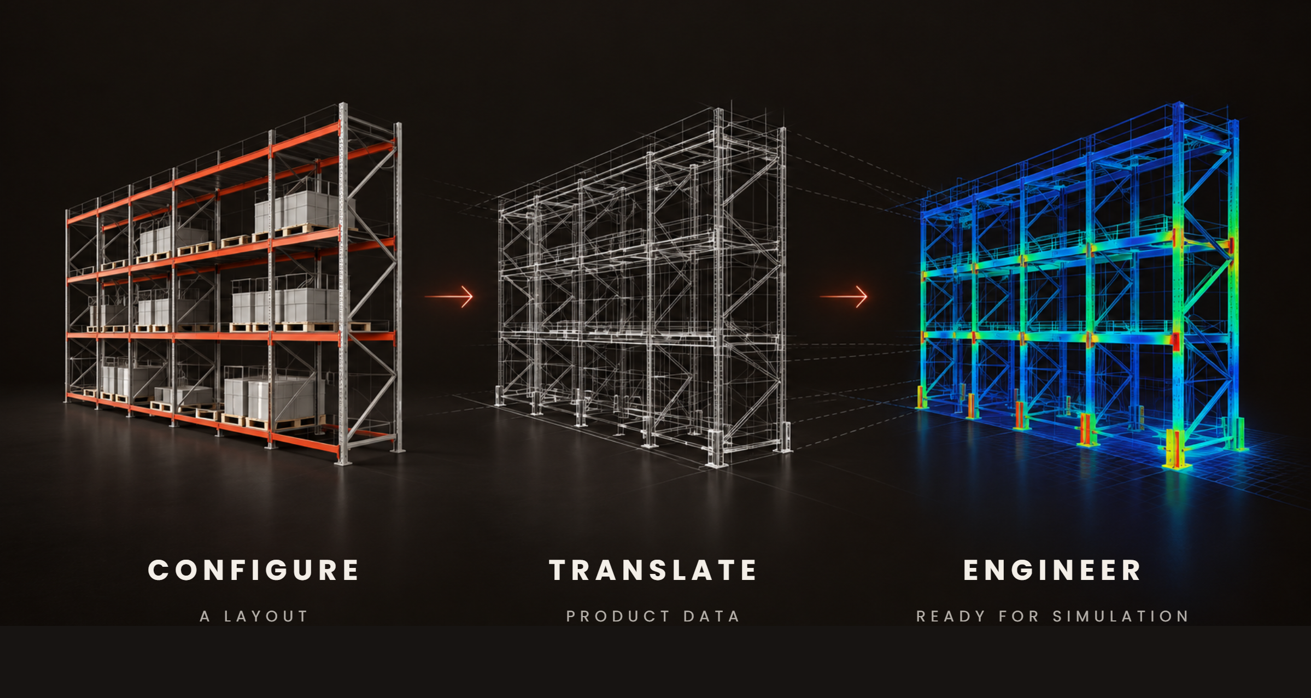
AI can interpret the customer's needs and guide the interaction. The configuration engine determines whether the resulting product is actually valid. The configuration can then be translated into geometry and engineering data, allowing the appropriate engineering process to validate the result.
That translation — from configuration to geometry to validated data — is exactly the kind of engineering automation we build for manufacturers
AI doesn't have to replace product configuration. It can make product configuration easier to use.
4. Use AI to reduce the work around quoting
Quoting is another area where AI can be useful. Not necessarily because AI should generate the final price — rather because there is often a lot of work surrounding the quote.
Most of it is the work nobody puts on a job description:
- · Collecting information and checking requirements
- · Finding relevant product information
- · Preparing descriptions and proposal content
- · Summarizing technical details
- · Following up on missing information
- · Connecting the output to CRM, ERP or other internal systems
Automating these smaller tasks can make a significant difference to quote turnaround time. And in complex-product sales, speed matters.
A faster quotation isn't simply an administrative improvement. It can mean a salesperson responds to more opportunities without adding the same amount of manual work. It also means fewer quotes waiting in a queue — the pattern we wrote about in why your engineers shouldn't have to approve every quote.
5. Use AI to connect with the product knowledge you already have
An AI model is only as useful as the information it can reliably work with. Manufacturers often have enormous amounts of product knowledge already.
It tends to live in places like:
- · Product databases
- · ERP systems
- · CAD data
- · Configuration rules
- · Engineering documentation and PDFs
- · Price lists
- · Previous projects
- · CRM systems
- · Internal knowledge
The opportunity isn't necessarily to replace all of this. It's to make it more accessible and useful. AI can become a new interface to information that already exists across the organization.
AI doesn't fix bad product data. It just makes the consequences faster.
But this is also why structured product data and connected systems matter. AI becomes much more powerful when it isn't operating in isolation.
6. And sometimes AI isn't the answer
This is perhaps the most important point. Not every manufacturing process needs AI.
Sometimes a simple automation is better. Sometimes a product configurator is better. Sometimes an ERP integration solves the problem. Sometimes the process itself needs to change before any technology is introduced.
And sometimes the best solution is a combination: AI plus product configuration plus automation plus integrations. The objective shouldn't be to put AI somewhere because AI is available. The objective should be to remove friction from the process. The cheapest automation is the process you no longer need.
So where should you start?
Instead of asking “Where can we use AI?”, start by mapping the process.
- Customer inquiry
- Requirements
- Product selection
- Configuration
- Pricing
- Quote
- Engineering
- Order
Then ask at each stage:
- · What is manual?
- · What takes too long?
- · Where do people repeatedly search for information?
- · Where does information get re-entered?
- · Where does engineering get involved?
- · Where are mistakes or iterations introduced?
And finally: is AI actually the right tool for this problem?
That last question is important. Because the goal isn't to build an AI-powered sales process. The goal is to build a better sales process. AI is one of the tools that can help get you there.
Where we see the biggest opportunity
For manufacturers selling complex products, the most interesting opportunities appear where AI meets structured product knowledge and existing business systems.
- AI
Understands the customer's request
- Configurator
Applies the product rules
- CPQ
Handles pricing and quoting
- Engineering systems
Validate the solution
- ERP & CRM
Carry the information into the rest of the business
The real opportunity is not any one of these technologies. It's connecting them. That's where complex product sales can start to feel very different.
The technology is the easy part. Finding where it creates real value is the interesting part.
Frequently asked questions
Is AI useful for manufacturers selling complex products?
Yes — in the places where unstructured information meets manual work: interpreting customer requests, finding the right product, and preparing quotes. AI is at its best when it prepares information for a system or person that can be trusted to decide. Product rules, pricing logic and engineering validation should stay in systems you control.
Can AI replace a product configurator?
No. A configurator applies your product rules and guarantees that a configuration is actually valid. AI can help a customer describe what they need and guide them toward the right options, but the rules that determine what can be built should come from a source of truth — not from a language model's best guess.
Should AI calculate product prices?
Not on its own. The price should be calculated by rules in your CPQ or ERP that you can audit and trust. AI can prepare the inputs — collecting requirements, identifying the right products, assembling the draft quote — which is where most of the time is actually lost.
Can AI replace engineering validation?
No. AI can translate a configuration into geometry and engineering data so validation can start earlier, but the validation itself should be done by your engineering process. AI makes the input better; it doesn't sign off the result.
Where should a manufacturer start with AI?
Map your quote-to-order flow first. Find the steps that are manual, slow, or where information gets re-entered. Then decide tool by tool — sometimes the answer is AI, sometimes a configurator or integration, and sometimes the process itself needs to change.
Complexity made simple
Map your quote-to-order flow with us and we'll be honest about which steps need AI, which need a configurator, and which just need a better process.
Send meeting request