
Your Engineers Shouldn't Have to Approve Every Quote
Quick test. Pull last month's engineering-reviewed quotes and count how many actually got changed.
If the answer is “almost none”, your engineers aren't reviewing. They're rubber-stamping — at engineer prices, at engineer lead times.
That's the engineering bottleneck in sales, and it's one of the most expensive habits a manufacturer can have, precisely because it doesn't feel like a habit. It feels like being careful.
What is the engineering bottleneck in sales?
It's what happens when every routine quote has to pass through engineering before it can go to the customer. Not the genuinely new applications — those should see an engineer. The ordinary ones. The 12-bay system at a standard height. The configuration your team has quoted four hundred times.
- · Sales can't send a quote without an engineering sign-off
- · Engineers spend hours per week checking configurations they could validate in their sleep
- · Quote turnaround is measured in days, and most of those days are queue time
- · Dealers and salespeople “pre-check” with engineering before even building the quote, because they've learned not to trust their own tools
None of this is caused by bad engineers or lazy salespeople. It's caused by product knowledge living in people instead of systems.
Why does every quote end up on an engineer's desk?
Because the rules exist only in engineers' heads — the load calculations, the compatibility checks, the “you can't combine that beam with that frame” knowledge. When the rules aren't written down anywhere executable, the only way to validate a quote is to ask the person who knows them.
And here's the uncomfortable math. Research from Salesforce shows sales reps already spend only around 30% of their time actually selling. Add an engineering queue on top, and your quote process runs on the calendar overlap between your busiest engineers and your least available reps.
Meanwhile, McKinsey found that responding to RFQs within 48 hours can lift win rates by roughly 25% — and industry studies consistently show 35–50% of deals go to whoever answers first. Every day a quote sits in the engineering queue is a coin flip you didn't have to take.
How do you remove the bottleneck without removing engineers?
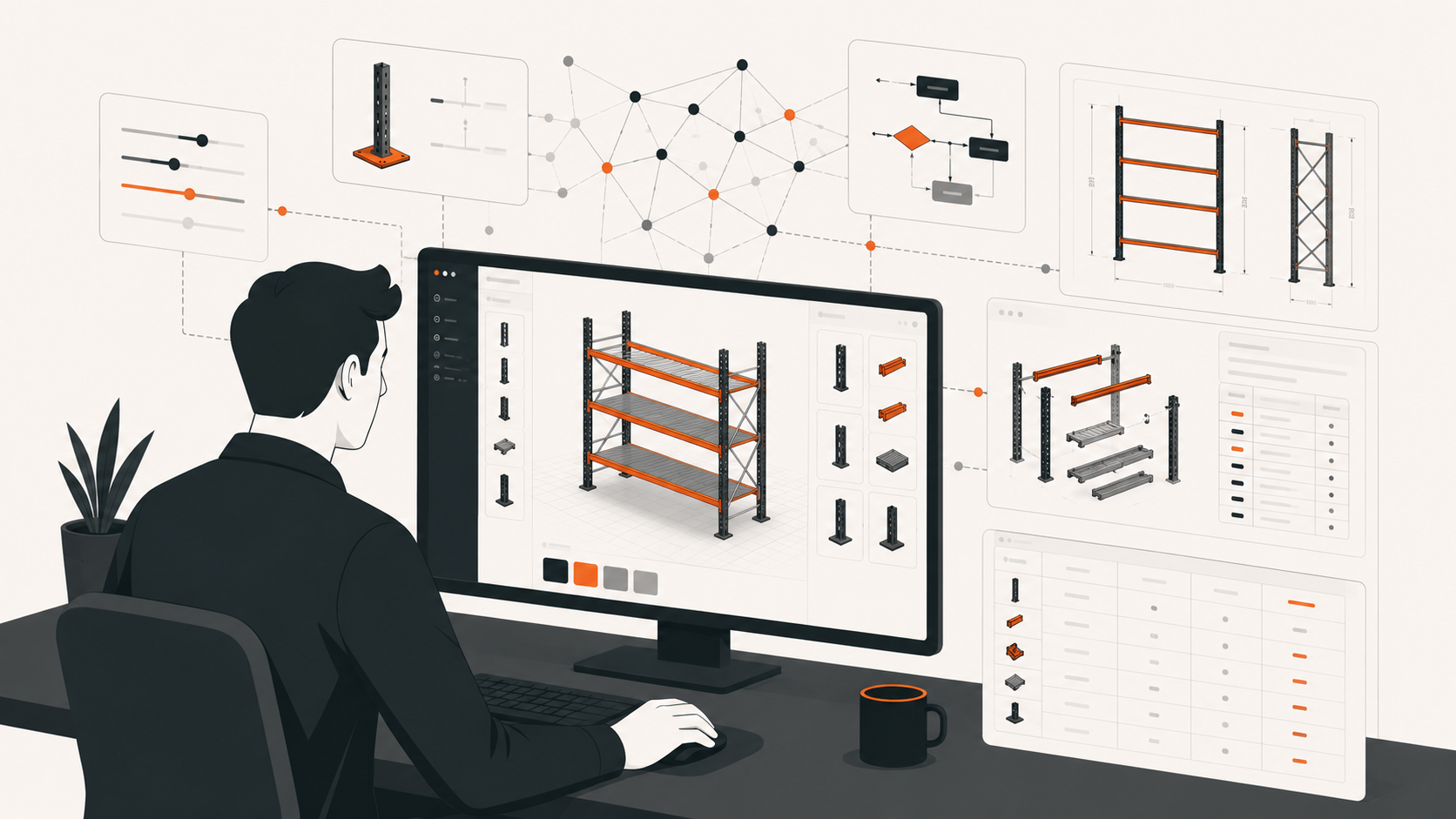
You move the engineering upstream. Instead of engineers checking every configuration after it's built, their knowledge gets embedded into the sales process itself — as rules, calculations and constraints inside a product configurator — so standard configurations validate themselves while they're being created.
The engineer stops being a checkpoint and becomes an author. They define the rules once and maintain them as the product evolves, instead of re-performing the same check per quote, forever.
That was exactly the shape of the problem at BLS — Brännehylte Lagersystem, a Swedish racking manufacturer. Great engineers, solid products, and every routine quote queued up behind the same specialists anyway. We embedded their engineering intelligence directly into the sales workflow. The results:
faster proposals
less internal resource per deal
engineering bottlenecks
Note what that last number does not say. Not zero engineering — zero queue. The genuinely exceptional orders still reach engineering. They just arrive as actual exceptions, with the full configuration, dimensions and calculations attached, instead of as ticket #4,117 between two ordinary ones.
Which quotes should still go to engineering?
The honest ones. A good setup automates what's understood and escalates what isn't:
A standard dimensional limit
Rule itA known compatibility check
Rule itA recurring calculation
Automate it once it's provenA completely new application
Engineer it — with context, and fast
Both failure modes are worth naming. If everything gets sent to engineering “just to be safe”, the configurator becomes an expensive intake form. If nothing does, you have software confidently making decisions nobody defined — and for load-bearing products, that's not a UX problem, it's a safety problem.
There's a bonus hiding in the exception lane: if the same exception keeps appearing, it's telling you something. Maybe a rule is missing. Maybe the product needs a new module. Your exception log quietly becomes product-development input.
What's the business case?
Take your last 50 quotes that needed engineering involvement and categorize why. In our experience, a surprising share of that work isn't engineering at all — it's process wearing an engineering costume. The ratio is usually the whole business case on one page.
Then ask the question that matters:
FAQ
What causes an engineering bottleneck in the sales process?
Product rules — calculations, compatibility constraints, dimensional limits — that exist only in engineers' heads. When knowledge isn't captured in a system, every quote must be validated by the person who holds it.
Does automating quote validation mean replacing engineers?
No. It shifts engineering work upstream: engineers define and maintain the rules once instead of manually re-checking routine configurations. Genuine exceptions still reach engineering — better prepared than before.
How much faster can quoting get?
It depends on how much of your engineering involvement is routine. BLS reached 33% faster proposals with the bottleneck fully removed. Measuring your own baseline — engineering touches per quote, days in queue — comes first.
Sources
Want to know where your queue actually is?
Bring us your last 50 engineering-reviewed quotes. We'll help you separate the real engineering from the process wearing an engineering costume.
Talk to us