
What does a product configurator cost?
Short answer: from around 10k to 100k+ EUR, depending on product complexity, the features you need and the systems it has to talk to. The longer answer is more useful — because a configurator is not a thing you buy once.
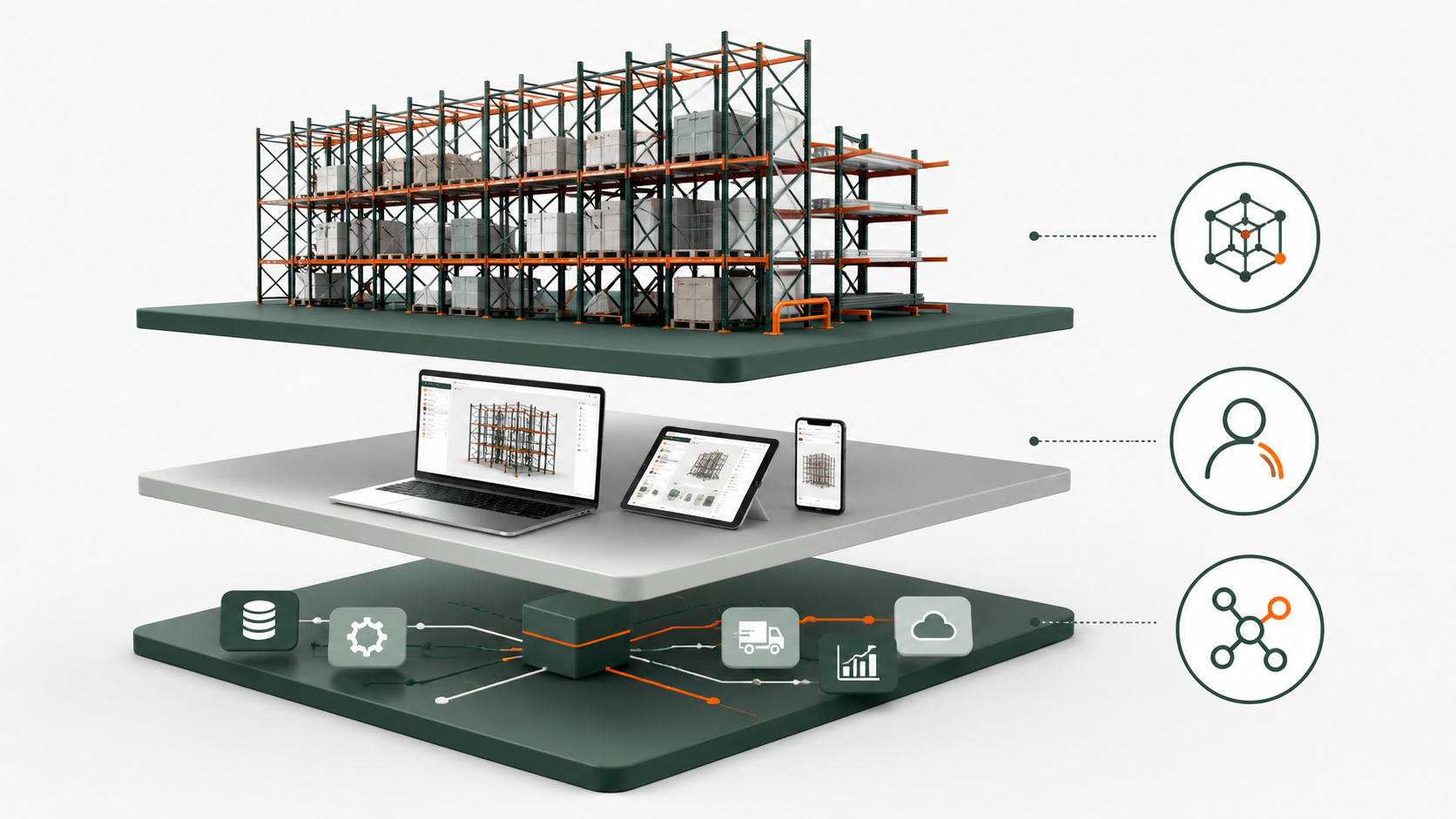
Most manufacturers ask for a price before they know the scope. That is fair, but it is the wrong order. The cost of a configurator is driven by how complex your products are, how many rules govern them, what has to be visualised, and which systems (ERP, CRM, PDM, CAD) it needs to exchange data with.
We build the vision together, then execute in deliverable phases. Phase one solves one product category and one set of challenges. Phase two builds on it. That is how our customers have worked with us for six to seven years — and why every one of them is still with us.
Indicative budget bands
These are typical first-phase investments, not price lists. Note what they have in common: all three can include the same feature set — 2D/3D visuals, rules, quote output. What moves the price is complexity, integrations and how much work you automate.
Same feature set, contained complexity
- · One product family
- · 2D/3D visualisation
- · Rules a sales rep can follow
- · Quote or specification output
Same features, more rules and one real integration
- · Several product families
- · Deeper rule and calculation logic
- · One system integration (ERP or CRM)
- · Dealer or internal sales access
Same features, automated engineering and data flows
- · Broad catalogue coverage
- · Automated dimensioning and BOM
- · Several integrations and data flows
- · Multi-language, multi-market rollout
Below roughly 10k EUR you are buying a prototype, not a production tool. Above 100k EUR you are usually looking at several phases rather than one project.
Why automation, not features, drives the price
Two configurators can look identical on screen and differ by a factor of three in cost. The difference is how much thinking the software does for the user.
Take a company selling warehouse racking. A sales person configures a bay in a nice graphical tool — but still decides manually which beam to use. That requires real product knowledge: is the beam over-dimensioned, or not strong enough for the load? When unsure, the question goes to engineering and the quote waits.
The visuals were the easy part. The data and the decision are still handled by hand, so the gain is fractional: a prettier quote, the same lead time.
The fix is to build the engineering rules into the tool — standard load calculations that pick the correct beam as the sales person designs the warehouse. Now the workflow is genuinely faster, engineering stops answering the same question, and sales can sell. But encoding those calculations, validating them and keeping them maintainable is a much larger task than drawing the bay.
So when you compare quotes, do not compare feature lists. Compare how many manual decisions each solution removes — that is what you are actually paying for, and it is where the return comes from.
Why phased delivery costs less than a big bang
A configurator that tries to cover everything on day one is the most expensive way to build one. We split the vision into phases that each pay for themselves.
Phase 0 — Vision
We map products, rules, sales flow and systems, and agree what good looks like. Scope becomes concrete instead of a guess.
Phase 1 — First product category
One category, live, used by real sales people. Value starts before the rest of the catalogue is touched.
Phase 2 — Expand and integrate
More categories, deeper rules, and the first real data flow into ERP, CRM or production.
Phase 3+ — Compound
Automated documents, dealer portals, new markets. Each phase reuses what already exists, so unit cost drops over time.
Custom-built vs platform-based configurators
There is no universally right answer — there is a right answer for your product complexity.
| Factor | Custom-built | Platform-based |
|---|---|---|
| Up-front cost | Higher first phase | Lower entry, licence per year |
| Cost over 5 years | Flattens — you own it | Grows with users and licences |
| Rule complexity | No ceiling | Fine until you hit the platform's limits |
| Integrations | Built for your ERP/CRM/PDM | Whatever connectors exist |
| Time to first value | Weeks per phase | Fast for standard products |
| Best fit | Complex, engineered-to-order products | Simple, catalogue-style products |
How to calculate the ROI
The return rarely comes from one number. It comes from four places, and you can estimate all of them from data you already have.
Engineering hours
Hours spent on quote support, drawings and revisions × loaded hourly cost. This is usually the single largest line.
Quote turnaround
Days from request to quote. Shorter cycles mean more quotes per rep and higher win rates on time-sensitive deals.
Error cost
Rework, credits and late deliveries caused by invalid specifications that a rule engine would have blocked.
Sales capacity
Dealers and customers configuring themselves, 24/7, without occupying your internal team.
A simple first pass: (annual engineering hours saved × hourly cost) + (avoided error cost) − (first-phase investment + annual run cost) = year-one return. Most of our customers reach payback inside the first phase or two.
What that looks like in practice
Typical time from start to a live first phase
Valid configurations covered by a single rule set
Online availability for dealers and customers
Common questions
Why can't you give a fixed price up front?
We can — per phase, once scope is defined. What we will not do is quote a full multi-year programme before we understand your products and rules, because that price would be either padded or wrong.
What are the ongoing costs?
Hosting, maintenance and continued development. Hosting and maintenance are modest; most of the ongoing spend is the next phase, which you decide to fund because the previous one paid off.
How long until it is live?
A focused first phase typically goes live in around twelve weeks, depending on data readiness and how quickly rules can be confirmed.
What do you need from us?
Product data, the rules that live in people's heads, and a decision-maker who can confirm them. Data quality is the most common thing that moves a timeline.
Get an estimate for your scope
Tell us about your products and where sales slows down. We will come back with a realistic first-phase scope and budget range.
Talk to us